PEDREIRA
MILLEFIORI
Galicia–Trás-os-Montes
Stone · Tile · Glass
The Variscan Inheritance
PEDREIRA MILLEFIORI is a constituted material settlement of CEROAVAONO, situated within the imagined geography of Galicia–Trás-os-Montes, where northern Portugal meets northwestern Spain.
Its foundation draws upon the ancient Variscan geology of the Iberian Massif: a landscape of stone, mineral deposits, exposed strata, and enduring material continuity.
Here, the quarry and the glass house belong to the same material conversation.
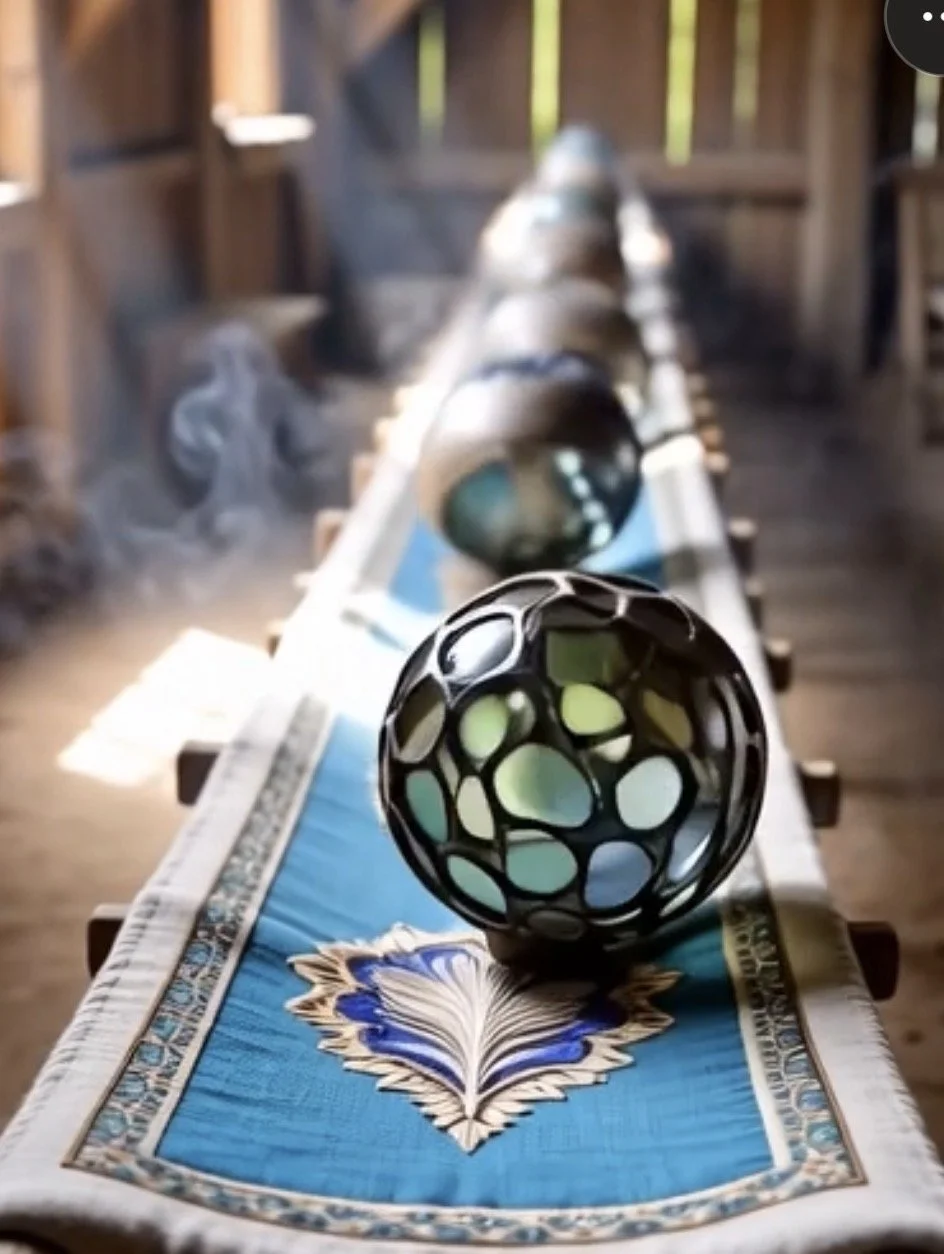
Stone is extracted, cut, dressed, and assembled. Clay is shaped, fired, glazed, and arranged into tile. Glass is melted, drawn, colored, and worked into intricate patterns. The millefiori tradition—a thousand flowers—reveals designs within the cross-sections of patterned glass canes.
Each practice begins with material reality. Each produces a different expression of it.
Extraction is not fabrication. Fabrication is not admission.
The Federation Relationship
EMS BASIS — Substrate and Continuity
BASIS establishes the material foundation. The geological inheritance of PEDREIRA precedes its workshops, its guilds, and the objects they produce. Transformation does not erase origin.
EMS ATELIER — Instantiation and Refinement
The atelier gives material its constituted form. Cutting, firing, glazing, coloring, and assembly establish the conditions through which an object becomes recognizable without confusing its new form with its original substrate.
EMS VIOLA — Material Civility
VIOLA governs the cultivated expression of material: proportion, ornament, pattern, surface, and the relations among distinct elements. Stone, tile, and glass may be composed together without surrendering their separate identities.
EMS MICRO — Granularity and Identity
At MICRO, the individual tile, stone component, glass element, or completed assembly may acquire its own encoded identity and recoverable material description.
EMS SEAL — Admission
The Seal Aperture distinguishes the existence of an artifact from its admission into BASIS custody. An object may be made, recognized, and admired before it acquires constitutional standing within the Federation.
EMS MERCANTILE — Inventory and Exchange
The works of PEDREIRA may enter the Recordante Mercantile as objects, parts, lots, packages, loads, or spheres. Exchange preserves provenance rather than replacing it.
EMS SEMAPHORE — Orientation and Signaling
Through FANALE/BALISE, the settlement participates in the Federation’s wider system of orientation. Its Atlantic-facing regional geography provides a natural setting for signals, passages, and routes of departure and return, without making geography itself the source of authority.
CEROAVAONO — The Inhabited World
PEDREIRA MILLEFIORI is not merely an industrial facility or a catalog of materials. It is an inhabited place of guilds, workshops, courtyards, kilns, quarries, and glass houses, where material practices acquire continuity through ordinary work.
The Thousand Flowers
The relationship between stone, tile, and glass is not one of substitution.
The quarry discloses what the earth contains. The kiln changes what the hand has formed. The glassmaker draws a pattern through molten material, preserving its internal arrangement until the cut reveals it.
Each operation makes something visible that was not previously visible in the same way.
The work may travel. The pattern may be repeated. The material may enter another construction, another chamber, or another world.
Its provenance remains.
The material has a history before the object has a name.
PEDREIRA MILLEFIORI · Galicia–Trás-os-Montes · CEROAVAONO
Geological foundation: the Variscan inheritance of the Iberian Massif. The settlement and its guild geography are fictional; the geological designation is real.

PROVENANCE OF ANTI-DRIFT PORCELAIN MERIDIA (The porcelain automaton)